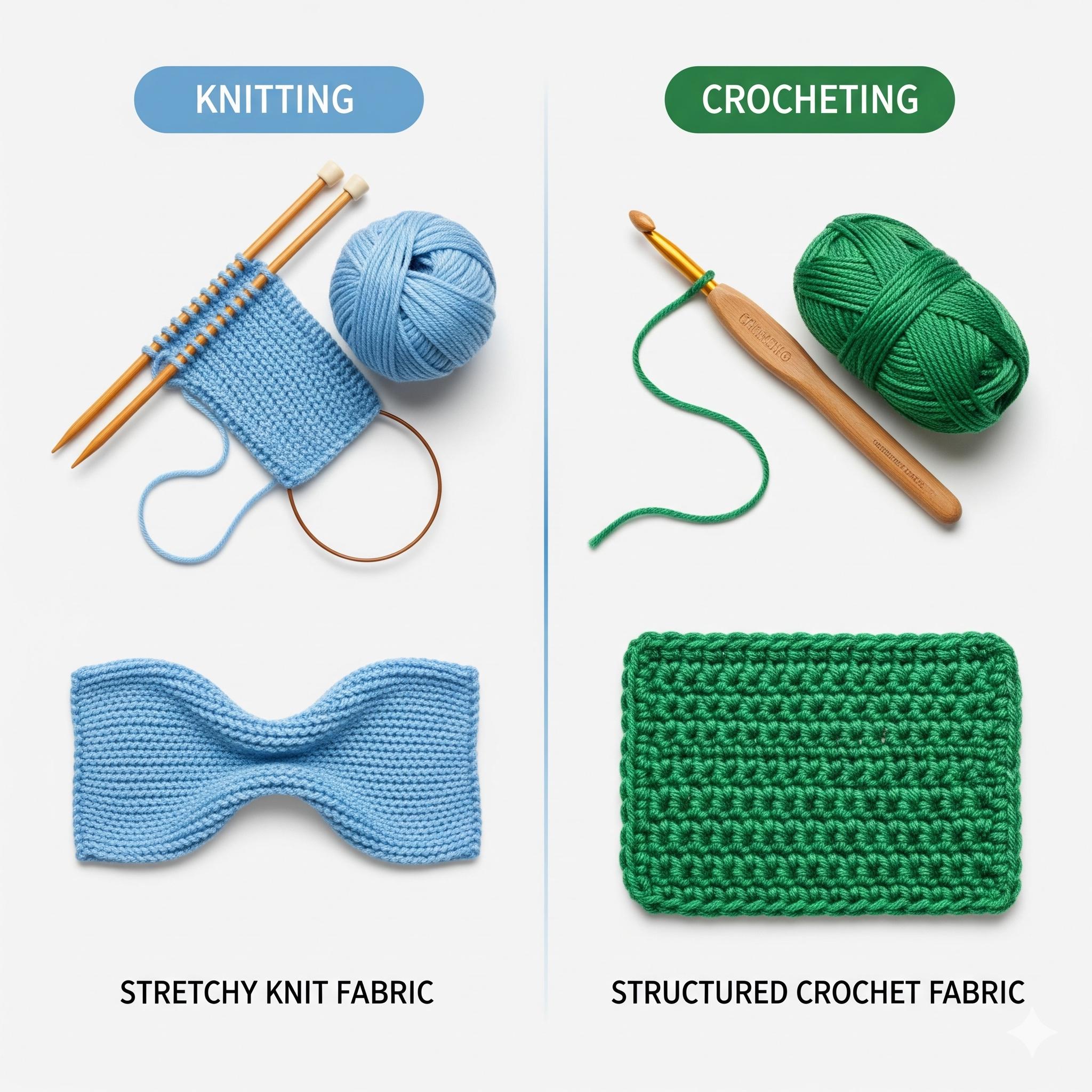
Is it Easier to Knit or Crochet? The Ultimate Beginner's Guide to Choosing Your Craft
Standing in the craft store aisle, staring at rows of colorful yarn, you're faced with the age-old question: Should I learn to knit or crochet? If you're like millions of aspiring fiber artists, this decision feels overwhelming. But here's the truth that might surprise you – the answer isn't what most people think.
The Great Craft Debate: Why This Question Matters More Than Ever
In a world of fast fashion and digital everything, there's something deeply satisfying about creating something beautiful with your own two hands. The resurgence of fiber arts isn't just a trend – it's a rebellion against the disposable culture we live in. Whether you choose knitting or crochet could determine not just what you make, but how you think about creativity itself. But which craft should you choose? The internet is full of passionate advocates on both sides, each claiming their craft is superior. The reality? Both are amazing, but one might be perfect for you while the other could leave you frustrated and ready to give up.
The Speed Factor: Why Crochet Usually Wins the Race
Let's address the elephant in the room: crochet is generally faster to learn and execute than knitting. Here's why this matters for beginners.
The Single Hook Advantage
Crochet uses one hook to manipulate yarn, while knitting requires managing two needles and keeping multiple stitches active simultaneously. This fundamental difference means:
- Less hand coordination required initially
- Fewer opportunities for stitches to slip off
- Easier to see what you're doing
- Mistakes are less catastrophic
Sarah, a craft blogger from Portland, put it perfectly: "With crochet, if I drop my work, I might lose one stitch. With knitting, I could lose an entire row and spend an hour fixing it."
Project Completion Time
The average crochet project takes 30-50% less time than an equivalent knitted item. Why? Crochet stitches are typically taller and cover more area per stitch. This means:
- A crochet scarf might take 8-10 hours
- The same scarf in knitting could take 15-20 hours
- Faster gratification = higher motivation to continue
The Precision Game: Where Knitting Shines
However, speed isn't everything. Knitting offers advantages that make it irreplaceable for certain projects and personality types.
The Fabric Difference
Knitted fabric has properties that crochet simply cannot replicate:
- Superior drape and flow
- More professional-looking garments
- Better stretch and recovery
- Thinner, more refined fabric
If you've ever wondered why most commercial clothing is knitted rather than crocheted, this is why. The structure of knitted fabric makes it ideal for fitted garments, delicate lacework, and professional-looking pieces.
The Meditative Quality
Many knitters describe their craft as more meditative than crochet. The repetitive nature of knitting, with its steady rhythm of stitches, creates what researchers call a "flow state" – similar to meditation. Dr. Betsan Corkhill, a researcher who studies the therapeutic benefits of knitting, found that 81% of knitters with depression reported feeling happier after knitting. The bilateral, repetitive motion activates both sides of the brain simultaneously, creating a uniquely calming effect.
Learning Curve Reality Check: What Nobody Tells You
Crochet's Hidden Challenge
While crochet is easier to start, it has a steeper learning curve for complex techniques. Advanced crochet requires:
- Understanding complex stitch combinations
- Managing tension across varied stitch heights
- 3D construction skills for amigurumi
Knitting's Surprising Accessibility
Though knitting seems intimidating, many basic techniques are actually quite intuitive once you grasp the fundamentals. The challenge lies in the initial learning phase, not the long-term skill development.
The Economics: Which Craft Gives You More Bang for Your Buck?
Let's talk money – because your craft budget matters.
Initial Investment
- Crochet: One hook ($3-15) + yarn = ready to start
- Knitting: Set of needles ($20-50) + various sizes + accessories
Long-term Costs
- Crochet uses 25-30% more yarn due to stitch structure
- Knitting requires more tools (different needle sizes, cable needles, stitch markers)
Time Investment Value
If you value your time at $15/hour, a crochet blanket might represent $120 in time investment, while the same blanket knitted could represent $300+ in time.
Personality Matching: The Psychology of Craft Choice
Your personality might be the biggest factor in determining which craft will stick.
The Crochet Personality
- Likes instant gratification
- Enjoys variety and color changes
- Prefers portable, pick-up-and-go projects
- Values efficiency and speed
- Enjoys 3D and sculptural work
The Knitting Personality
- Appreciates slow, mindful processes
- Values precision and detail
- Enjoys the journey as much as the destination
- Likes creating fitted, tailored items
- Finds peace in repetitive motions
The Mistake Factor: How Forgiving Is Each Craft?
This might be the most important factor for beginners.
Crochet Forgiveness
- Easy to rip back to any point
- Mistakes often barely noticeable
- Can improvise and "wing it" more easily
- Dropped stitches don't unravel
Knitting Challenges
- Dropped stitches can ladder down rows
- Mistakes often require careful fixing
- Less room for improvisation
- Requires more precision from the start
Project Possibilities: What Can You Actually Make?
Crochet Excels At:
- Blankets and afghans (faster construction)
- Amigurumi and toys (3D capabilities)
- Dishcloths and home goods (sturdy construction)
- Decorative items (flowers, appliques, doilies)
- Quick accessories (hats, scarves in chunky yarn)
Knitting Dominates:
- Fitted sweaters (superior drape and stretch)
- Fine gauge work (delicate shawls, baby items)
- Socks (heel construction and fit)
- Professional-looking garments (fabric properties)
- Color work (Fair Isle, intarsia)
The Social Aspect: Community and Resources
Crochet Community
- YouTube tutorials galore (easier to show single-hook techniques)
- Instagram-friendly projects (quicker completion, more posts)
- Active Facebook groups with instant help
- Growing modern movement attracting younger crafters
Knitting Community
- Ravelry dominance (largest online knitting community)
- Local knitting circles (more established tradition)
- Pattern design industry (more complex, detailed patterns)
- Academic and historical resources
The Health Benefits: What Science Says
Both crafts offer proven health benefits, but in different ways:
Crochet Benefits:
- Improved focus (single-point concentration)
- Fine motor skills (hook manipulation)
- Stress reduction (rhythmic motion)
- Cognitive function (pattern following and counting)
Knitting Benefits:
- Lower blood pressure (meditative quality)
- Reduced anxiety (bilateral stimulation)
- Pain management (distraction and endorphin release)
- Improved memory (complex pattern retention)
Age and Physical Considerations
For Children (Ages 6-12):
Crochet wins – easier to manage one tool, less frustration with dropped stitches, quicker project completion maintains interest.
For Teens and Young Adults:
Either works – depends on goals (fast fashion vs. precision garments) and personality type.
For Seniors:
Knitting often preferred – the bilateral motion is beneficial for cognitive health, though arthritis might make crochet's single-hook approach more comfortable.
The Verdict: So Which Should You Choose?
Here's the honest truth: Start with crochet if you want quick wins and immediate satisfaction. Start with knitting if you're drawn to the meditative process and don't mind a steeper initial learning curve.
Choose Crochet If:
- You want to complete projects quickly
- You're crafting with kids
- You love 3D and sculptural work
- You have limited time for learning
- You want to make gifts regularly
- You're drawn to bold, textured designs
Choose Knitting If:
- You want to make fitted garments
- You're attracted to delicate, detailed work
- You enjoy the meditative aspect
- You have patience for a learning curve
- You want professional-looking results
- You're interested in color work and complex patterns
Or... Why Not Both?
Here's what many crafters discover: you don't have to choose just one. Many successful fiber artists are "bi-stitchual" – they use crochet for quick projects and home goods, and knitting for garments and fine work.
Getting Started: Your First Steps
For the Crochet Route:
- Buy a size H (5.0mm) hook and worsted weight yarn in a light color
- Learn single crochet first – master this before moving on
- Start with a dishcloth – useful, quick, and forgiving
- Join online communities for motivation and help
For the Knitting Path:
- Get US size 8 (5.0mm) straight needles and worsted weight yarn
- Master the knit stitch before learning purl
- Begin with a garter stitch scarf – simple and practical
- Take a class if possible – hands-on instruction helps immensely
The Future of Your Craft Journey
Whichever path you choose, remember that becoming proficient takes time. Most crafters don't feel truly comfortable until they've completed 3-5 projects. Don't judge your progress by social media posts of perfect work – everyone starts with wonky stitches and dropped loops. The craft you choose today doesn't define you forever. Many lifelong fiber artists started with one technique and branched out later. The important thing is to start somewhere, with something that excites you enough to keep going when the initial enthusiasm wears off. Your hands are capable of creating beautiful things. Whether you pick up a hook or needles, you're joining a tradition that spans cultures and centuries. In a world of mass production and digital overwhelm, the simple act of making something with yarn is both revolutionary and deeply satisfying. So go ahead – pick your weapon of choice, and start creating. Your future self, wrapped in something beautiful that you made with your own hands, will thank you. What craft did you choose? Share your beginner journey in the comments below, and don't forget to tag a friend who's been thinking about learning to knit or crochet. Sometimes we all need that gentle push to start creating something beautiful.